
1. The 12-Second Standard
Here's a number that should make you uncomfortable: 1 hour and 47 minutes.
That's the average time it takes a dealership to respond to an internet lead, according to Foureyes' 2025 Dealership Lead Response Study. Not 5 minutes. Not 15 minutes. Almost two hours.
And that's the average. It includes the dealerships that do respond quickly. It also includes the 43% of leads that, according to Cox Automotive's 2024 Buyer Journey Study, never get a response at all.
Meanwhile, the data on what happens when you respond fast is unambiguous:
- 78% of buyers purchase from the first business that responds to their inquiry (Vendasta, 2024; corroborated by Harvard Business Review)
- Responding within 5 minutes makes you 100x more likely to connect with the lead compared to waiting 30 minutes (MIT/InsideSales Lead Response Management Study)
- 61% of leads receive zero follow-up after the initial contact attempt (Foureyes, 2025)
These aren't opinions. They're measured, peer-reviewed, and replicated. The relationship between response speed and conversion is one of the most well-documented phenomena in sales.
So why 12 seconds — not 5 minutes, not 1 minute?
Because the buyer is still on their phone. They just submitted the form. They're still looking at the vehicle listing. Their intent is at its absolute peak — and it decays with every passing second. A 12-second response catches the buyer in the moment of maximum engagement, before they tab over to the next dealer's website, before they start second-guessing whether they even want to buy right now.
Five minutes is the threshold where contact probability drops off a cliff. Twelve seconds means the buyer hasn't even put their phone down yet.
Speed to Lead isn't a product name we made up to sound fast. It's a measurable standard. Diablo AI is engineered to respond to every inbound lead within 12 seconds of form submission — with a personalized, context-aware message that starts a real conversation. Not an autoresponder. Not "thanks for your inquiry." A response that demonstrates knowledge of the vehicle, the offer, and the buyer's intent.
2. What Happens in Those 12 Seconds
Twelve seconds sounds impossible if you're thinking about what a human has to do: read the lead, look up the vehicle, check inventory, think about what to say, type a message, and hit send. That process takes 5-15 minutes even for a fast BDC agent — and that's if they're sitting at their desk, not on another call, and notice the lead immediately.
Here's what actually happens inside Diablo AI during those 12 seconds:
Second 0-1: Webhook Fires
The lead form submits. A webhook fires from the lead source (website form, Google Vehicle Listing Ad, Meta lead form, third-party marketplace) and hits Diablo's ingest layer. The lead is parsed: name, phone number, email, vehicle of interest, source, UTM parameters, timestamp.
Second 1-4: Context Building
The AI pulls context from three sources simultaneously:
- Inventory: Is the vehicle the buyer asked about in stock? What trim? What price? Are there similar vehicles available if the exact one is gone?
- Dealer configuration: What's the dealer's name? What offers or promotions are currently running? What are the business hours? Who should receive escalations?
- Customer history: Has this person submitted a lead before? Is there an existing conversation? A previous vehicle of interest? Previous objections?
Second 4-8: Response Generation
Claude AI generates a personalized response. This is not a template. The AI writes a message specific to this buyer, this vehicle, and this moment. If the buyer asked about a 2025 Silverado LT and there are three in stock, the AI mentions the specific trim, the current pricing, and the Spring Event offer — because it knows the campaign context from the UTM parameters.
The response is conversational. It reads like a knowledgeable salesperson who actually looked at the vehicle the buyer asked about — because the AI did.
Second 8-12: Delivery
The message is sent via SMS and/or email, depending on the dealer's configuration and the information available. The lead is logged in the CRM with the full conversation thread attached. The clock starts on the follow-up cadence.
Total elapsed time: 12 seconds. The buyer is still on their phone. They submitted a lead form and got a text from the dealership before they could even navigate away from the page.
What This Looks Like to the Buyer
The buyer's experience: "I submitted a form asking about a Silverado, and within seconds I got a text from the dealer that mentioned the exact truck, the price, and a current offer. They asked me when I'd like to come see it."
Compare that to the industry average experience: "I submitted a form on Tuesday night. Nobody called me until Thursday morning. By then I'd already been to two other dealers."
3. The Follow-Up Problem
Speed gets the conversation started. But speed alone doesn't sell cars. The real gap in dealership lead handling isn't just the first response — it's everything that comes after.
According to Foureyes' 2025 study, 61% of dealership leads receive zero follow-up after the initial contact attempt. One call. One email. Then the lead sits in the CRM and ages until it's eventually marked "lost" or simply forgotten.
The problem isn't laziness. It's math. A BDC agent handling 40-60 active leads doesn't have time to execute a persistent follow-up cadence on every one. They focus on the leads that respond, and the ones that don't respond get one or two attempts before the agent moves on to fresher leads. It's rational behavior given the constraints — but it leaves the majority of your pipeline untouched.
The Persistence Gap
| Follow-Up Attempt | Typical BDC | Diablo AI |
|---|---|---|
| First response | 1h 47m average | 12 seconds |
| Second attempt | Next day (if at all) | 4 hours later |
| Third attempt | Rarely happens | Day 2 |
| Fourth attempt | Almost never | Day 4 |
| Fifth attempt | Never | Day 7 |
| Long-term follow-up | Non-existent | Continues for months |
Most "speed to lead" tools in automotive focus exclusively on the first response. They fire off a quick reply and then hand the lead to a human for follow-up. That's like winning the first lap of a race and then pulling into the pit for the rest of it.
Diablo doesn't just respond first. It follows up. It varies the message. It changes the angle. If the first message was about the vehicle, the second might be about the current promotion. If the buyer went quiet after mentioning price concerns, the follow-up addresses value — not just price. The AI adapts its approach based on the buyer's behavior, and it doesn't stop until the buyer engages, books, or explicitly opts out.
Speed gets the door open. Persistence walks through it. Most tools do one or the other. You need both.
4. Afterhours: The Hidden Goldmine
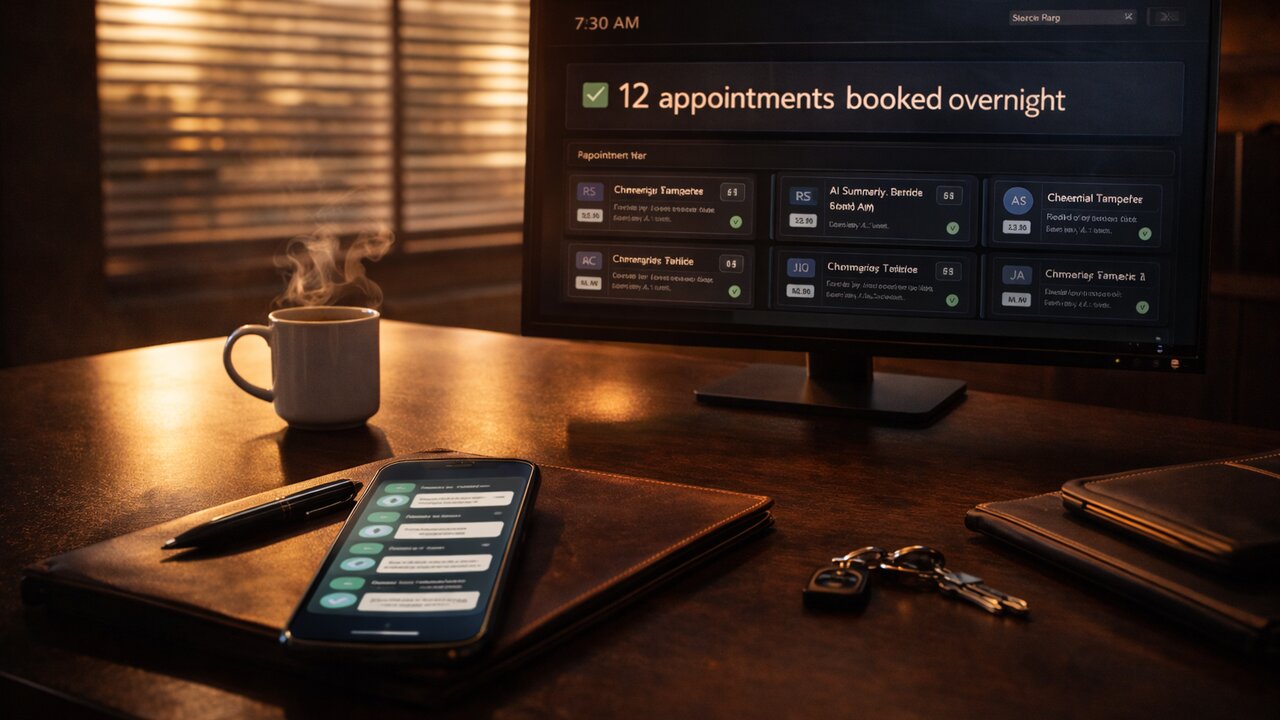
Fifty-six percent of dealership leads arrive outside of business hours — evenings, nights, and weekends (NADA / Better Car People, 2025). That's not a rounding error. It's the majority of your inbound pipeline, arriving when nobody is there to answer.
Think about when people shop for cars. They're at work during the day. They start browsing in the evening — after dinner, on the couch, on their phone. They compare vehicles. They check prices. At 9:30 PM, they find the truck they want and submit a lead form. Then they wait.
And wait. And wait.
The average response time for after-hours leads is approximately 17 hours (Better Car People, 2025). A lead submitted at 9 PM on Tuesday doesn't hear back until 2 PM on Wednesday. By then, the buyer has slept, gone to work, and may have heard from a competitor who responded faster.
Two Products, One Problem
Diablo addresses this with two Speed to Lead tiers:
| Feature | Speed to Lead Afterhours | Speed to Lead 24/7 |
|---|---|---|
| Price | $699/mo | $1,899/mo |
| Coverage | Outside BDC hours only | All hours, every day |
| Response time | 12 seconds | 12 seconds |
| Follow-up cadence | Multi-step, persistent | Multi-step, persistent |
| Appointment booking | Yes | Yes |
| Objection handling | 5-level framework | 5-level framework |
| Best for | Dealers with strong daytime BDC | Dealers who want AI handling every lead |
Afterhours ($699/mo) is for the dealership with a BDC team that handles leads effectively during the day but has zero coverage from 6 PM to 8 AM and on Sundays. The AI activates when the team goes home and deactivates when they arrive in the morning. Every after-hours lead gets a 12-second response instead of a 17-hour wait.
24/7 ($1,899/mo) is for the dealership that wants AI handling every lead, all the time. During business hours, the AI is the first responder — faster and more consistent than any human team. The BDC can then focus on warm handoffs, complex conversations, and in-person customer interactions instead of racing to be the first to reply.
The math on Afterhours is straightforward. If 56% of your leads arrive after hours and you're currently responding to those leads 17 hours late, you're losing deals to competitors who respond faster. At $699/month, you need to recover one additional deal every two to three months to be ROI-positive — and the data on speed-to-lead suggests you'll recover significantly more than that.
5. Objection Handling
The biggest misconception about AI lead response is that the AI is just a fast autoresponder — it sends a quick message, and then it's done. That's what most chatbots do, and that's why most chatbots produce mediocre results.
Diablo doesn't just respond. It engages. And when a buyer pushes back — "I'm just looking," "I'm not ready yet," "I need to talk to my wife" — the AI doesn't fold. It follows a structured 5-level objection handling framework designed for automotive conversations.
Level 1: Acknowledge
The AI validates the buyer's concern without being dismissive. No pressure, no argument — just acknowledgment.
"I completely understand — most people are in the research phase when they first reach out. Totally normal."
Level 2: Add Value
The AI provides information that's useful to the buyer regardless of their timeline. This builds credibility and keeps the conversation open.
"Just so you know, that Silverado LT you were looking at is one of three we have on the lot right now. The Spring Event pricing on it ends April 30 — I can send you the full breakdown if that'd be helpful."
Level 3: Low-Risk Ask
The AI proposes something that requires minimal commitment — not "come in today" but a smaller step that moves the conversation forward.
"Would it be helpful if I sent you some photos of the truck and the current pricing? No commitment — just so you have it when you're ready."
Level 4: Either/Or Close
If the buyer is engaged but noncommittal, the AI presents two options instead of an open-ended question. This makes it easier for the buyer to say yes to something.
"If you did want to come take a look, would a weekday evening or Saturday morning work better for you?"
Level 5: Graceful Exit
If the buyer is genuinely not interested right now, the AI doesn't burn the bridge. It sets up for future contact and leaves the buyer with a positive impression.
"No worries at all. I'll keep your info on file — if anything changes or you want to revisit, just text me back anytime. Good luck with the search."
The key principle: soft "no" does not mean "never." A buyer who says "I'm just looking" is not a dead lead. They're an early-stage lead. The AI treats them accordingly — it doesn't pressure them into an appointment they're not ready for, but it also doesn't give up and let them slip into the abyss of your CRM's "lost" bucket.
Most BDC agents hear "I'm not interested" and move on. The AI hears "I'm not interested yet" and adjusts its approach. That distinction accounts for a significant portion of recovered appointments.
6. When the AI Steps Back
The best AI isn't the one that handles everything. It's the one that knows when to stop.
Diablo monitors its own confidence level throughout every conversation. When it detects a scenario it shouldn't handle alone, it escalates to a human — not by dumping the lead in a queue, but by packaging the conversation for a clean handoff.
What Triggers an Escalation
- Complex trade negotiations: The buyer has a specific trade-in question that requires appraisal-level detail the AI doesn't have
- Emotional situations: The buyer is frustrated, upset, or referencing a previous negative experience with the dealership
- Explicit request: The buyer says "I want to talk to a person" or "can I speak with a manager"
- Credit-sensitive conversations: The buyer raises specific financing concerns that require human judgment
- Multi-vehicle or fleet inquiries: Complex buying scenarios that go beyond standard retail
The Handoff Package
When the AI escalates, it doesn't just transfer a phone number. It delivers a handoff package to the assigned team member that includes:
- Conversation summary: What was discussed, what the buyer is interested in, what objections were raised
- Customer intent score: How engaged is this buyer? Are they shopping or buying?
- Vehicle of interest: Specific stock number, trim, and pricing that was discussed
- Recommended next step: What the AI would have said next, so the human can pick up seamlessly
- Full conversation transcript: So the buyer never has to repeat themselves
The human who picks up the call or sends the next message isn't starting from scratch. They're picking up a warm conversation with full context. The buyer's experience is seamless — they went from texting with the dealership's AI to texting with a salesperson, and the salesperson already knows everything that was discussed.
Why This Matters
Dealers who've been burned by chatbots have every right to be skeptical. Most chatbots are dumb. They follow scripts. They can't handle nuance. And when they fail, they fail publicly — sending awkward, irrelevant, or tone-deaf messages that damage the dealership's reputation.
The difference with Diablo is that the AI is self-aware about its limitations. It doesn't try to be a replacement for your best salesperson. It tries to do the things your best salesperson shouldn't be spending time on: responding to initial inquiries in 12 seconds, following up persistently for weeks, and engaging buyers who would otherwise go completely untouched.
When the conversation reaches the point where human skill, judgment, or empathy adds real value — the AI gets out of the way. That's not a limitation. That's the design.
AI handles the volume. Humans handle the complexity. The dealerships that figure out that division of labor first will outperform everyone else.